[Cape Canaveral, Florida, December 17, 2017, rke– English below ] – « Il est parti
comme un oiseau dans le ciel bleu enfin libre et heureux », disait la
chanson dans les paroles du chanteur Georges Moustaki.
Si le lancement d’une fusée devient de nos jours aussi banal que le départ
d’une voiture, chaque tir reste et restera en quelque sorte une prouesse, car
c’est à chaque fois un condensé d’intelligence humaine qui booste la technique
jusqu’à la première seconde du décollage. C’est pour cette raison que
l’adrénaline monte peu à peu jusqu’au moment où la fusée décolle. La maîtrise
de l’atterrissage d’un étage est à elle seule une prouesse technologique
d’autant plus grande, car ce sont des ingénieurs, donc des humains, qui ont
conçu les algorithmes mathématiques nécessaires à la descente du bout de fusée
qui fonce sur Terre comme un météore et dont il faut maîtriser la descente. Et
même si Jessica Jensen, directrice de la mission Dragon chez SpaceX a déclaré
qu’elle préfère l’atterrissage plutôt que le décollage (voir vidéo), suite à ma
question posée lors de la post-conférence après le dernier décollage de Falcon,
les deux phases de vol représentent un tour de force.
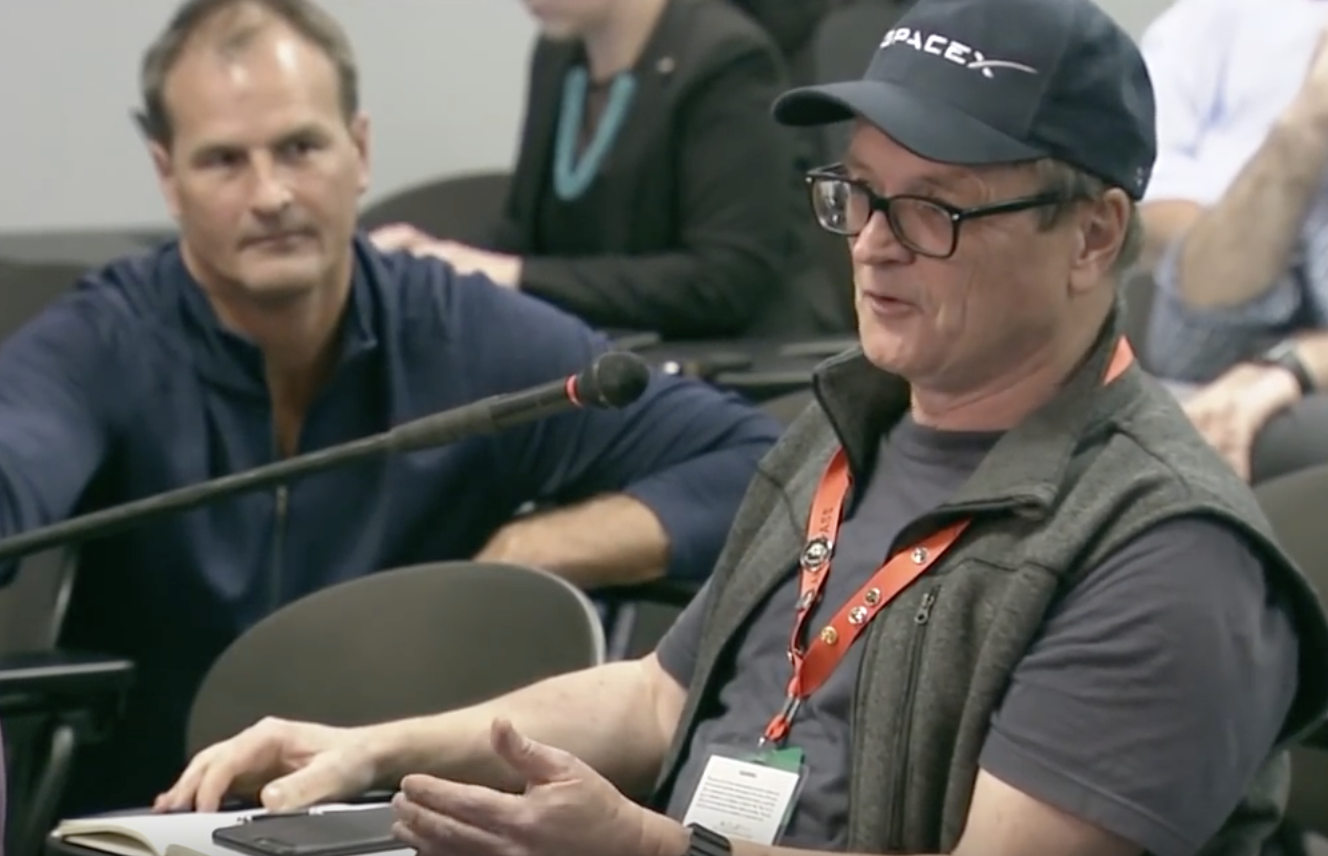
Jessica Jensen during the post-briefing at De.c 15, 2017. - Photo : rke
SpaceX : The Falcon 1st Stage Dark
as a Controlled Meteor
[Cape Canaveral, Florida, December 17, 2017, rke] – "He
left like a bird in the blue sky finally free and happy," said the song in
the words of the French singer Georges Moustaki.
If the launching of a rocket becomes as trite as the departure of a car, each
shot remains and will remain in a way a feat, because it is each time a
condensed human intelligence that boosts the technique until at the first
second of take-off. That's why adrenaline rises little by little until the
rocket takes off. The mastery of the landing of a stage is itself a
technological prowess all the more important, because many engineers, therefore
humans, who have designed the mathematical algorithms necessary for the descent
of the end of the rocket that rushes on Earth like a meteor and whose descent
must be mastered. And though Jessica Jensen, director of SpaceX's Dragon
mission, said she prefers landing rather than taking off (see video), following
my post-conference question after Falcon's last take-off, the two phases of
flight is an accomplishment.
The descent on Cape Canaveral. Photo taken with a camera on the 1st stage. - Photo NASA TV
Le pas de tir 39A (au fond) attend la prochaine mission : SpaceX Heavy ! - Photo : rke
[Cape Canaveral, Florida, December 16, 2017, rke– English below ] – Avec un brin de nostalgie, je me souviens des décollages des fusées Saturne où, étant tout gosse, je suivais les vols Apollo à la TV. À l’époque, fin des années 60 et début des années 70, deux présentateurs vedettes ont animé les émissions sur ce sujet, le plus souvent en direct. Il y avait tout d’abord de feu Georges Kleimann pour la Suisse romande (ex TSR) puis aussi et surtout le Dr Bruno Stanek pour la Suisse alémanique (SRF). Bien que, en son temps, je n’avais pas une grande envie de me brancher sur la langue de Goethe, j’ai toujours eu une grande admiration pour ce dernier qui apportait - et apporte encore via le web - une plus-value scientifique à ses propos. À l’occasion de ma présence ici à Cap Canaveral, je lui ai demandé pourquoi il pensait que SpaceX est meilleur que toute autre entreprise spatiale d’aujourd’hui. De Suisse, il me répond à travers ce blog, ce qui, en quelque sorte, m’honore.
Décollage de SpaceX-Dragon CRS 13 le
15 décembre 2017, 10h36 (locale).
Photo prise pardon collègue sur place, Julian Leek.
Dr Bruno
Stanek :« SpaceX a réussi à atteindre le
sommet de tous les développeurs de fusées en moins d'une décennie, tandis que
les anciens dirigeants, malgré tout le soutien du gouvernement, semblent
n'avoir fait aucun progrès technologique au cours de la même décennie. SpaceX a
démontré sa capacité à franchir les premières étapes coûteuses et a offert la
perspective de lancer des fusées à coût abordable sur une base régulière.
Leur technologie, qui démontre qu’un moteur de Methane-LOX sous-congelé peut atteindre
l'orbite terrestre en une seule étape, devient possible. Cela rend les percées
encore plus faciles: les deuxièmes étages – construits comme des orbiteurs,
rendant les carénages de charge utile obsolètes – peuvent être ravitaillés en
orbite terrestre et peuvent voler vers la Lune ou vers Mars avec juste plus ou
moins de carburant. Choisir du méthane plutôt que du kérosène, c'est produire
du CH4 à partir de CO2 et de H2O sur Mars pour
le vol de retour. Construire leur propre complexe de lancement à Boca Chica
(Sud du Texas) les rend indépendants des installations gouvernementales et
militaires – alors que la plupart e ceux-ci lancent des fusées super lourdes.
De quoi avez-vous besoin de plus ? Et ils ont d'autres idées exclusives qui ne
sont pas faciles à copier. SpaceX a frappé la concurrence totalement non
préparée, surtout l'industrie de la fusée en Russie, en Chine et en Europe. »
www.stanek.ch
Dr. Bruno
Stanek : « SpaceX hit the competition totally unprepared, above all
the rocket industry in Russia, China and Europe. »
Dr. Bruno Stanek during one of his Space-trip in Cape Canaveral.
Photo taken from the SpaceX Control Center of Port Canaveral.
[Cape Canaveral, Florida, December 16, 2017, rke] – With a touch of
nostalgia, I remember lift-off Saturn rockets where, being a kid, I watched
Apollo flights on TV. At the time, in the late '60s and early' 70s, two
featured presenters hosted shows on the subject, mostly live. First of all there
was Georges Kleimann (died in 2010) for French-speaking Switzerland (formerly
TSR) and then and above all Dr. Bruno Stanek for German-speaking Switzerland (SRF).
Although, in its time, I did not really want to learn German, I always had
great admiration for Bruno Stanek who
brought - and still brings via the web - a scientific added value. On the
occasion of my presence here in Cape Canaveral, I asked him why he thought
SpaceX is better than any other space company today. From Switzerland, he
answers me through this blog, which, in a way, honors me.
Dr. Bruno Stanek near the "first stage
landed" at SpaceX headquarters in
Hawthorne (CA) on Crenshaw Blvd.
Le Dr Bruno Stanek (de dos) avec Georges Kleimann (décédé en 2010) dans la salle de contrôle d'alors des vols Apollo.
Dr. Bruno
Stanek :« SpaceX has succeded to rise to
the top of all rocket developers within less than a decade, while the ancient
leaders, despite all government support, seem to have made no technological
progress within the same decade. SpaceX has demonstrated the ability to land
the expensive first stages and offered the prospect to launch for a fraction of
the cost on a regular basis. Their technology of a sub-frozen
Methane-LOX-engine is progressed to the point, where reaching Earth orbit on a
single stage becomes feasible. This makes further breakthroughs much easier:
second stages are built like orbiters, make payload fairings obsolete, can be
refueled in Earth orbit and can fly to either the Moon or Mars with just more
or less fuel. Choosing Methane instead of Kerosene let's them produce CH4 from CO2 and H2O on Mars for the return flight. Building their own launch complex in
Boca Chica (South Texas) makes them independent from government and military
facilities - and most limits launching super-heavy rockets. What do you need
more? And they have additional proprietary ideas that are not easy to copy.
SpaceX hit the competition totally unprepared, above all the rocket industry in
Russia, China and Europe. »
Georges Kleimann (à gauche) et le Dr Bruno Stanek.
Riding a column of brilliant flame from
nine Merlin 1D main engines, the Falcon 9 rocket climbed away from Cape
Canaveral’s Complex 40 launch pad at 10:36:09 a.m. EST (1536:09 GMT) Friday,
turning northeast over the Atlantic Ocean to align with the space station’s
orbital track. -Photo : rke
Rétro-fusées. Le premier signe du retour. Photo : rke
[Cape Canaveral, Florida, December 15, 2017, rke– English below ] – « En cas d’accident,
évacuez immédiatement du côté ouest du building. » Alors que nous sommes perchés
à 160 m de hauteur sur le fameux VAB, sur le toit, les ordres n’ont pas changé.
En cas de pépin, donc d’explosion comme ce fut le cas le 1er
septembre 2016 avec la fusée Falcon 9 (qui avait d’ailleurs détruit un
satellite Facebook), il faut tout laisser tomber et se barrer a toute vitesse.
Cela dit, une fois sur le toit, le vaste panorama qui s’offre à nos yeux donne
un sentiment qu’il ne peut rien arriver. Nous sommes comme des aigles à l’affût
des tours de lancement qu’on distingue nettement au loin (nous sommes quand même
à 5 km à vol d’oiseau). Et de cette hauteur, on distingue mieux l’allumage des
moteurs.
Les choses ont bien changé. Autrefois, après chaque
décollage, on pliait bagage au plus vite pour redescendre du toit. Maintenant
notre attention se focalise davantage sur le retour du 1er étage de
la fusée. On doit scruter toute l’étendue du ciel, la tête bien inclinée pour
l’apercevoir. Et c’est seulement lorsque ses moteurs sont allumés générant
comme une grosse étincelle, qu’on le distingue enfin. L’étage devient de plus
en plus visible. On remarque au loin la trajectoire légèrement recourbée que le
mène à son point de chute. Une chute d’ailleurs parfaitement maîtrisée et,
contrairement à un hélicoptère qui se pose comme un papillon, la descente d’un
étage de fusée est telle une grosse flèche qui fait mouche !
[Cape Canaveral, Florida, December 15, 2017, rke
] – "If an accident occurs, for your safety, evacuate
immediately to the west side of the building. " While we are installed at 525
feet on the famous VAB (on the roof), the orders have not changed. In case of problems,
so an explosion as was the case on September 1, 2016, with the rocket Falcon 9
(which had destroyed a Facebook satellite), you must drop everything and to
leave at full speed. That said, as soon as we are on the roof, the vast
panorama that presents itself to our eyes gives a feeling that nothing can
happen. We are like eagles on the lookout for launch towers that can be clearly
seen in the distance (we are still 5 km as the crow flies). And from this
height, we see better ignition engines.
Things have changed a lot. In the past,
after each take-off, luggage was packed as fast as possible to get off the
roof. Now our attention is focused more on the return of the 1st stage of the
rocket. We must scrutinize the whole expanse of the sky, our head well inclined
to see it. And it is only when its engines are lighted generating like a big
spark that one finally see it. The 1st stage becomes more and more visible. In
the distance we can see the slightly curved path that leads to its point of
fall. A fall perfectly controlled and, unlike a helicopter that lands like a
butterfly, the descent of a rocket stage operates like a big arrow that reached
its target.
Descent of the 1st stage of Falcon 9.
- Photo : rke
[Cape Canaveral, Florida, December 15, 2017, rke– English below
] – L’objet de convoitise, ici, vous savez ce que c’est ? Le PAD 40. Comme
vous pouvez le voir sur la carte ci-jointe, il s’agit d’un pas de tir (SLC 40) dédié
à SpaceX-Falcon. Jusqu’à l’explosion de la fusée Falcon du 1er
septembre 2016, tous les lancements de SpaceX se sont déroulés là ! Il y a
donc un plus d’un an, ce fut un rude coup pour l’entreprise d’Elon Musk. L'explosion
du lanceur avait été provoquée par l'explosion initiale d'un des trois
réservoirs d'hélium logés à l'intérieur du réservoir d'oxygène liquide de
l'étage supérieur. Les ondes de choc ont vaporisé l'oxygène liquide. De
fines gouttelettes de vapeur qui se sont alors formées ont enflammé le kérosène qui
a fait voler en éclat le lanceur et le satellite à son bord. Donc, depuis cette
date, les autres décollages de SpaceX ont eu lieu du PAD 39A, celui que SpaceX
a racheté à la NASA.
Or, le lancement de SpaceX Dragon CRS-13 prévu
demain vendredi à 10h35 locale, 16h35 (heure suisse), a justement lieu depuis ce
fameux PAD 40. La NASA, qui s’occupe des médias en tant que prestataire pour
SpaceX, nous a concocté une visite exclusive sur le lieu, de nuit à 1h du matin,
pour faire plus fun. Je me réjouissais donc de voir la rénovation de cet
endroit.
Du coup, me voilà seul reporter étranger accrédité sur place
Une quinzaine de photographes et reporters –
dont moi-même resté le seul étranger du contingent – ont eu rendez-vous sur le
parking de l’un des deux bâtiments des badges (PIDS). Après une bonne heure
d’attente dans le bus qui devait nous amener sur le site de lancement, SpaceX nous annoncé qu’il était
préférable d’abandonner la partie, comme ce fut le cas trois jours avant la
première tentative de lancement. On est rentrés bredouilles ne le prenant pas
trop mal, pour certains d’entre nous. SpaceX semble ayant eu encore besoin de
temps de peaufiner le site et sa fusée. Ce PAD 40 génère pour nous passa pas mal de tribulations.
PAD 40
tribulations : when reporters & photographers go home empty-shooted
No shoot this time. Maybe later. -Photo : rke
[Cape Canaveral, Florida, December 15, 2017, rke] - The subject of
predilection, do you know what is it ? PAD 40 ! As you can see on the map
opposite, this is a SpaceX-Falcon (SLC 40) launch pad. Since the Falcon rocket
explosion on September 1, 2016, all SpaceX launches took place there! So it's
been over a year, it was a big blow for Elon Musk's company. The explosion of
the launcher was caused by an initial explosion of one of the three helium
tanks inserted inside the upper-stage liquid oxygen tank. The shock waves
vaporized the liquid oxygen. Fine droplets of vapor that formed then ignited
the kerosene that shattered the launcher and the satellite on board. Since that
date, SpaceX's other take-offs have been from PAD 39A, which SpaceX has bought
from NASA.
So, I am the only foreign reporter accredited However, the launch of SpaceX Dragon CRS-13
expected tomorrow Friday at 10:35 am local time, 16:35 pm (Swiss time), is
taking place precisely on the famous PAD 40. NASA, which deals with the media
as a provider for SpaceX, we concocted an exclusive visit to the place, night
at 1am, to make more fun. I was therefore looking forward to seeing the
renovation of this place.
Fifteen photographers and reporters -
including myself, the only foreigner in the contingent - had a meet at the
parking of one of the two badge buildings (PIDS). After a good hour of waiting
in the bus that was to bring us to the launch site, SpaceX announced that it
was better to abandon the trip to PAD 40, as was the case three days before the
first launch attempt. We came home empty-handed not taking it too bad for some
of us. SpaceX seems to have needed more time to refine the site and its rocket. This PAD 40 causes us a lot of tribulations.
L'aiguille implantable biosensorielle.pour une meilleure régulation du glucose qui sera testée dans l'espace.
- Photo : Biorasis
Les deux intervenants à la conférence
"What's on board". Dr Alessandro Grattoni of
Houston Methodist Research Institute and
Dr Yasamah Shirazi, mission scientist (HRC)
- Photo : rke
[Cape Canaveral, Florida, December 14, 2017, rke]
– Alors que le lancement de SpaceX Dragon CRS-13 se fait attendre en raison de
procédures de vérifications du lanceur (par précaution), nous autres
journalistes et reporters avons été conviés à assister à un briefing scientifique
très étoffé baptisé : « Quoi de neuf à bord ». Eh oui, la
capsule Dragon n’emporte pas que du matériel aux astronautes de la Station
spatiale internationale (ISS, mais aussi des expériences scientifiques. Une douzaine
de celles-ci sont donc embarquées et je vais vous en faire découvrir quelques-unes
au fil de mon périple américain.
Petite précision. En orbite, les conditions de
microgravité permettent d'étudier les impacts sur la vie biologique et les
écoulements de fluides. Les expériences sur ce vol rejoignent ainsi
quelques-unes des 329 expériences en cours. Ce porte à ce jour 2’465
expériences et à plus de 1’300 publications provenant de la recherche sur les
stations spatiales.
Par exemple, la start-up Biorasis
basée dans le Connecticut (entre New York et Boston), cherche à utiliser
l'environnement de microgravité de la station spatiale pour améliorer la
précision des biocapteurs de glucose sans fil implantables médicalement pour la
gestion quotidienne du diabète. Le « Center for Advanced of Science in Space » (CASIS) a parrainé cette recherche
en partenariat avec Boeing / MassChallenge. Le transport lent du glucose dans
les tissus humains (à travers les parois capillaires et les tissus environnants
vers le site de détection du biocapteur) peut entraîner des retards pouvant
atteindre 20 minutes dans la surveillance en temps réel des niveaux de glucose.
Ce retard peut être préjudiciable à la réalisation d'un contrôle glycémique
serré, qui a été lié à des complications secondaires graves chez les patients
diabétiques. L'ISS fournit un environnement de microgravité dans lequel la
réduction du mouvement des fluides permet un suivi précis du rôle de la
diffusion dans le transport du glucose, améliorant ainsi les modèles
mathématiques qui déterminent la précision du biocapteur de surveillance
continue du glucose (Glucowizzard).
Atrophie des muscles : collaboration avec Novartis
Par ailleurs, l'Institut de recherche méthodiste de
Houstoncollabore avec le chef de file pharmaceutique suisse Novartis
pour évaluer l'efficacité d'un système de délivrance de médicaments
implantable. Launchpad Medical veut envoyer un matériau osseux synthétique,
capable d'adhérer l'os au métal en quelques minutes pour en accélérer la
réparation. L’espace est donc un environnement idéal à évaluer.
Diabetes: Dragon Embarks an Experiment to Improve Daily Glucose Management
The official badge of experiment with the partners.
Le badge officiel qui concerne l'expérience de l'atrophie des muscles- Photo : NASA
The briefing "What's on board".... - Photo NASA TV
[Cape Canaveral, Florida, December 14, 2017, rke]
– While the launch of SpaceX Dragon CRS-13 is slow due to launcher verification
procedures (as a precaution), journalists and reporters have been invited to
attend a rich scientific briefing called "What's on board". Yes, the
Dragon capsule not only carries material to the astronauts of the International
Space Station (ISS), but also scientific experiments, a dozen of them are
embarked and I will make you discover some over my American trip.
Clarification. In orbit, the microgravity
conditions that allow to investigate the impacts on biological life and fluid
flows. The experiments flying on SpaceX/CRS-13 will be joining some of the 329
experiments during Increment 53/54. Bringing us, to date, up to 2’465
experiments, and over 1’300 publications, that have come from space station
research.
...with many very attentive young people.
Well, almost. - Photo : NASA TV
A startup company, Biorasis, seeks to use the microgravity
environment of the space station to improve the accuracy of wireless, medically
implantable glucose biosensors for day-to-day diabetes management. The Biorasis
Glucose Biosensor investigation seeks to improve the accuracy of a wireless
medically implantable continuous glucose biosensor (Glucowizzard) for day - to
- day diabetes management.
The Center for Advanced of Science in Space (CASIS) sponsored this research in partnership
with Boeing/MassChallenge. Slow glucose transport within human tissue (through
the capillary walls and surrounding tissue toward the sensing site of the
biosensor) can create delays of up to 2 0 minutes in real - time monitoring of
glucose levels. This delay can be detrimental in achieving tight glycemic
control, which has been linked to serious secondary complications in patients
with diabetes. The ISS provides a microgravity environment in which reduced
fluid movement allows precisely monitoring of the role of diffusion in glucose
transport, thus improving the mathematical models that determine the accuracy
of the Glucowizzard continuous glucose monitoring biosensors.
Implants. - Photo : NASA TV
Collaboration with Novartis
Otherwise, the Houston
Methodist Research Instituteis partnering with the pharmaceutical
leader Novartis on a rodent research investigation to evaluate the efficacy of
an implantable drug delivery system that could assist those with muscle atrophy
on Earth. Launchpad Medical will send a synthetic bone material, capable of
adhering bone to metal within minutes to accelerate repair. This is an ideal
environment to evaluate a healing response and development of effective
treatments for patients needing bone repair.