[Cape Canaveral, December 5, 2018, rke (English, below] – Sous un ciel quasi limpide, la fusée Falcon 9 de SpaceX s’est envolée le 5 décembre à 13h16 (locale), 19h16 (Suisse) vers la Station spatiale internationale ISS pour ravitailler les 6 astronautes actuellement en orbite, dont un Allemand ( Sergey Prokopyev, Serena Auñón-Chancellor, Commander Alexander Gerst, Anne McClain,Oleg Kononenko, David Saint-Jacques), à 435 km d’altitude. La capsule Dragon a emmené de la nourriture fraîche (non moisie comme celle du jour d’avant) aux 20 petites souris astronautes dans l’espace depuis le 4 juillet 2018. Voici mes premières images sur place, NASA Causeway, à 6,5 km de distance, le plus proche. Sensations, émotions et délectation dans une prochaine news.
Le retour du 1er étage, en Floride. – Photo: rke
Dragon flies to feed "freshly" the 20 astronaut mice of the ISS
The little mice wait. – Photo: NASA
[Cape Canaveral, December 5, 2018, rke] - Under an almost clear sky, SpaceX Falcon 9 rocket flew on December 5 at 1:16 (East) to ISS international space station to supply the 6 astronauts currently in orbit, including a German ( Sergey Prokopyev, Serena Auñón-Chancellor, Commander Alexander Gerst, Anne McClain, Oleg Kononenko, David Saint-Jacques), at 435 km high. The Dragon capsule brought fresh food (no mold like the day before) to 20 little astronaut mice in space since July 4, 2018. Here are my first images on the spot, NASA Causeway, 6 miles away, the closest. Sensations, emotions and delight in a next news.
En Floride, à 32 degrés C., il fait lourd (orages). Les drapeaux sont en berne en raison du décès de George H. W. Bush,
mais les oiseaux adorent le toit des voitures. - Photo : rke
[Cape Canaveral, 4 décembre, 2018, rke (English, below] – Décidément, ça boom du côté des lancements. Du fait de reports successifs, deux décollages devaient avoir lieu un jour après l’autre. Celui de SSO-A (pas le Swiss Space Office) mais Spaceflight Smallsat Express, qui a eu lieu le 3 décembre 2018 à l’heure pile (10h34 locale, 19h34 Suisse, tiens c’est de nouveau à l’heure depuis que je suis là !) de la Californie (de l’autre côté de Cap Canaveral). Puis, CRS-16, une mission cargo, dont le décollage devait avoir lieu le lendemain 4 décembre, donc aujourd’hui. Seulement voilà. La NASA a annoncé un report d'une journée afin de laisser le temps aux équipes au sol de remplacer les barres de nourriture moisies destinées à 40 souris en route vers la Station spatiale internationale pour cette mission dans le cadre d'une expérience de recherche biologique. Des barres alimentaires fraîches devaient en effet être livrées à Cape Canaveral depuis le centre de recherche de la NASA Ames en Californie mardi pour être chargées dans la capsule Dragon.
Dans le fond, cette aventure m’arrange puisque je viens enfin d’obtenir mon badge, le vert, et que je peux préparer mon équipement-photo à poser au pied de la fusée Falcon 9. Je contrôlerai les céréales.
« Covoiturage » : satellites suisses à bord
Cela me permet de vous parler de SSO-A. En fait, il s’agit d’une grappe de 64 satellites placés autour d’un anneau à 6 branches dans lesquelles sont incrustés des mini satellites (1 dm3, le plus petit, 120 kg le plus gros) qui seront catapultés sur orbite. Eh, eh, pas mal la combine. Elle provient d’in ingénieux ingénieur, Curt Blake, qui s’est proposé de ranger ces engins de manière compacte et de proposer ses services de co-voiturage spatial aux entreprises ou autres. Du coup, l’affaire a plu à l’entreprise vaudoise Astrocast.
Les 64 microsatellites en orbite basse (huit par plan orbital) couvriront les zones inhabitées où les objets de l’internet des objets (IoT) ne seront pas connectés aux nouveaux réseaux terrestres dédiés de type LoRa ou Sigfox. D’où l’intérêt d’Astrocast car ce déploiement la positionne comme un opérateur de satellites dédiés à l’internet des objets avec aussi le déploiement d’une structure au sol et ses propres logiciels.
Astrocast embarque donc 3 cubes-satellites, mais L’EPFZ a aussi une charge utile pour l'orbitographie low-cost GNSS (u-blox) qui provient du laboratoire du professeur Markus Rothacher.
Vieille photo, belle gueule ?
Ah, au fait, la NASA a mis du temps à refaire mon nouveau badge parce que ma photo dans leur base de données datait de 2002. Du coup, comme ils (les administrateurs) ont remarqué que j’ai pris de la bouteille, ils ont voulu vérifier. Ironie de l’histoire : ma nouvelle photo (prise il y a dix jours dans leurs bureaux) était tellement vilaine qu’ils ont réimprimé la même que l’ancienne, sur le nouveau badge. Eh, eh, ça me rajeunit !
California: Falcon 9 takes off at time / Florida: the food of moldy mice
The SSO-A team in California. - Photo : SpaceX
[Cape Canaveral, 4 décembre, 2018, rke] Zealously, rocket launches have some panache! After successive postponements, two takeoffs were to take place one day after the other. Foremost, SSO-A (not the Swiss Space Office), Spaceflight Smallsat Express, which was launched on December 3, 2018 at time (10:34 local, 19:34 Switzerland, it's been on time again since I was there!) in California (On the other side of Cape Canaveral). Then, CRS-16, a cargo mission, who must take off December 4th, so today.
So, but it’s a little creasy. NASA has announced a one-day delay in SpaceX’s next cargo launch until Wednesday to allow time for ground teams to replace moldy food bars meant for 40 mice heading for the International Space Station as part of a biological research experiment, denying the launch company a chance at two Falcon 9 missions on back-to-back days.
Fresh food bars were to be delivered to Cape Canaveral from NASA’s Ames Research Center in California late Tuesday for loading into the Dragon capsule, but officials were racing a clock to seal the spacecraft’s hatch and raise the Falcon 9 rocket vertical for final countdown preparations in advance of a Tuesday afternoon liftoff.
Finally, this adventure suits me. Since I have got my badge, the green, I can prepare my photo-equipment to put at the foot of the rocket Falcon 9. I will be able to control the cereals.
Space-sharing: Swiss satellites on board
So, and so, SSO-A is a cluster of 64 satellites placed around a ring with 6 branches in which are inset mini satellites (1 dm3, the smallest, 264 lb largest) which will be catapulted into orbit. Eh, well, a good idea comes from an ingenious engineer, Curt Blake, who proposed to store these machines in a compact way and to offer its services of space-sharing to companies or others. As a result, the business appealed to the Swiss Astrocast company (Vaud State, Lausanne, Ouest of Switzerland).
These 64 microsatellites in low orbit (eight per orbital plane) will cover uninhabited areas where Internet of Things (IoT) objects will not be connected to new dedicated LoRa or Sigfox terrestrial networks. Hence the interest of Astrocast because this deployment positions it as a satellite operator dedicated to the Internet of Things with the deployment of a ground structure and its own software.
Astrocast therefore 3 satellite cubes, but the Swiss Federal Institute of Technology (ETHZ) also has a payload for the GNSS low-cost orbitography (u-blox), which comes from the laboratory of Professor Markus Rothacher.
Old photo, nice mouth ?
Ah, it says, NASA took a long time to redo my new badge because my photo in their database dated back to 2002. So, as they (the administrators) noticed that I have aged (a little) they wanted to control. Ironically, my new photo (taken ten days ago in their offices) was so ugly that they reprinted the same as the old one, on the new badge. Hey, it makes me look younger!
Les entrailles des flammes dans la tranchée de droite. - Photos : rke
Je m'y suis assis. Aie ! Fallait pas.
[Cape Canaveral, November 30, 2018, rke (English, below] – Décidément, ces lancements se suivent et se ressemblent. Après le lancement de Falcon 9/Es’hail 2(SpaceX) de Cape Canaveral le 15 novembre 2018, celui d’Antares (Northrop Grumman, Cygnus) depuis la Virginie le 17 novembre 2018, voici venir demain 2 décembre, le lancement de satellites express SSO-A Smallsat Express (SpaceX) avec une expérience suisse à bord. Je reviendrai sur ce sujet. Ces décollages se ressemblent, car ils proviennent de lanceurs privés. Cela est un fait. « Le prochain atterrissage lunaire des États-Unis sera effectué par des sociétés privées - et non par la NASA. » C’est ce qui ressort du discours de l’administrateur de la NASA, Jim Bridenstine, qui a annoncé vendredi 30 novembre que neuf sociétés américaines se feraient concurrence (liste ci-dessous) pour livrer des expériences sur la surface lunaire. L'agence spatiale achètera et laissera au secteur privé qui devront en déterminer détails pour y parvenir.
Contre-plongée sur l'une des tours (160 de haut).
Echappements.
Ce n’est donc pas étonnant si nous devons attendre aussi longtemps de voir voler enfin une fusée de NASA, la SLS, toujours en fabrication. Certes, cela se passe normalement, mais les deniers ne sont pas suffisants pour accélérer la production. Cependant, Donald Trump a décidé de mettre le turbo pour retourner sur la Lune au plus vite, comme producteur et non explorateur avant de conquérir l’espace lointain, dont Mars. Cela donne un petit coup de fouet, mais pas un gros coup de cravache. Car il faut trouver ces fameux sous, d’où la contribution du secteur privé.
Toujours est-il que, depuis le 8 juillet 2011, le dernier lancement d’une fusée habitée (la navette spatiale), le pas de tir « B »est en adaptation pour recevoir la nouvelle fusée SLS, celle-là qui devra renvoyer des hommes dans l’espace lointain. Il s’agit d’une mixture d’éléments modernisés entre une fusée Saturne et les propulseurs de la navette américaine. Oh, c’est pas mal. J’ai l’occasion de visiter le hall dans lequel on a pu voir quelques morceaux de fusées. Voir photos. Comme j’ai aussi eu la chance de fouler quatre fois le PAD (depuis le 9 juillet 2011), j’ai aussi enfin pu mettre les pieds dans la nouvelle tranchée des flammes (Launch Pad 39B Flame Trench Nears Completion) qui arrive enfin à terminaison. Ce couloir est essentiel pour dévier en toute sécurité les gaz d'échappement du panache de la fusée massive pendant le lancement. Mesurant 17 m de large, 13 m de haut et 21 m de long, le côté nord du déflecteur est incliné à un angle de 58 degrés environ et détournera l'échappement, la pression et la chaleur intense de la fusée vers le nord au décollage.
J’ai osé poser mes fesses sur ces déflecteurs de flammes en fonte, mais je me suis fait gronder. Pourquoi ? Elles ne sont pas assez solides pour me supporter ?
The Flame Trench. - Photos : rke
I Dared to Put my Butt on the Flame Trench of the Launch Pad B
Explanations in an SLS assembly hall.
[Cape Canaveral, November 30, 2018, rke] Really, these launches follow each other and are similar. After the Falcon 9 / Es'hail 2 (SpaceX) launch of Cape Canaveral on November 15, 2018; Antares (Northrop Grumman, Cygnus) from Virginia on November 17, 2018, here comes December 2. SSO-A express satellites Smallsat Express (SpaceX) launch with Swiss experience on board. I will come back to this topic. These takeoffs are similar because they come from private launchers. That is so! America's next moon landing will be made by private companies — not NASA. So, NASA Administrator Jim Bridenstine announced Thursday Nov. 30 that nine U.S. companies (see below) will compete to deliver experiments to the lunar surface. The space agency will buy the service and let private industry work out the details on getting there, he said. It's not surprising if we have to wait so long to finally see NASA's rocket, the SLS, still in production. Okay, this happens normally, but the money is not enough to speed up production. However, Donald Trump decided to put the turbo… to back on the moon as soon as possible, as a producer and not an explorer and so before conquering deep space, including Mars. This gives a little lash but not a big whip. Because it is necessary to find these famous pennies, hence the contribution of the private sector.
Always is it, since July 8, 2011, the last launch of a manned flight, Space Shuttle, the PAD B launch is always in adaptation to receive the new rocket SLS, the one that will have to send men in deep space. It is a mixture of modernized elements between a Saturn rocket and the thrusters of the American shuttle.
Oh, it's not bad. I have the opportunity to visit the hall where we could see some pieces of rockets (See photos). As I also had the chance to tread four times the PAD (since July 9, 2011), I was finally able to set foot in the new Launch Pad Flame Trench 39B Nears Completion which finally arrives at termination.
The main new flame deflector is critical to safely deflecting the plume exhaust from the massive rocket during launch. Measuring approximately 57 feet wide, 43 feet high and 70 feet long, the deflector's north is slanted at about a 58-degree angle and will divert the rocket's exhaust, pressure and intense heat to the north at liftoff. Two side deflectors soon will be installed. They will help to contain and protect the vehicle and surrounding pad structures from the solid rocket boosters during liftoff.
I dared to put my butt on these cast-iron flames, but I was scolded. Why? These are not strong enough to support me?
Nine U.S. companies will compete to deliver experiments to the lunar surface
Journée officielle de la réception du module de service Orion le 16 novembre 2018 au Centre des opérations du KSC.
– Photo: rke
Documents : ESA
[Cape Canaveral, November 27, 2018, rke (English, below] – Je reviens à vous, comme la grêle après les vendanges, comme on dit en Suisse. Et en France, je suppose. La NASA et l’agence spatiale européenne (ESA), nous ont dévoilé vendredi 16 novembre, dans le Centre des opérations du Kennedy Space Center (O&C High Bay Available SMEs), autrement dit le hangar des capsules Apollo réaménagé en salle de montage des bouts de fusées modernes, le module Orion. Beaucoup de beau monde pour cette inauguration officielle du Module de service (SM), tout le gratin des officiels. On n’a pas eu l’occasion d’interviewer ces gens-là à ce moment-là, mais lors de la conférence de presse qui s’est tenue ensuite au centre de presse du KSC.
Philippe Deloo. - Photo: rke
Johann-Dietrich Wörner ESA Director general. – Photo : rke
Orion, c’est le nouveau véhicule de la NASA pour explorer l’univers. D’abord la Lune, puis Mars, puis le reste. L’engin est compensé en deux parties : une habitable et l’autre consommable. C’est cette dernière qui a été inaugurée et je ne suis pas peu fier puisqu’elle provient un peu de Suisse. Ce module de service sert à… servir, ce qui veut dire que sans lui, rien ne peut plus fonctionner dans le véhicule habitable. C’est un peu comme si vous roulier sans moteur ni carburant, ni courant, ni chauffage, etc.
Mon badge.. parmi tant d'autres.
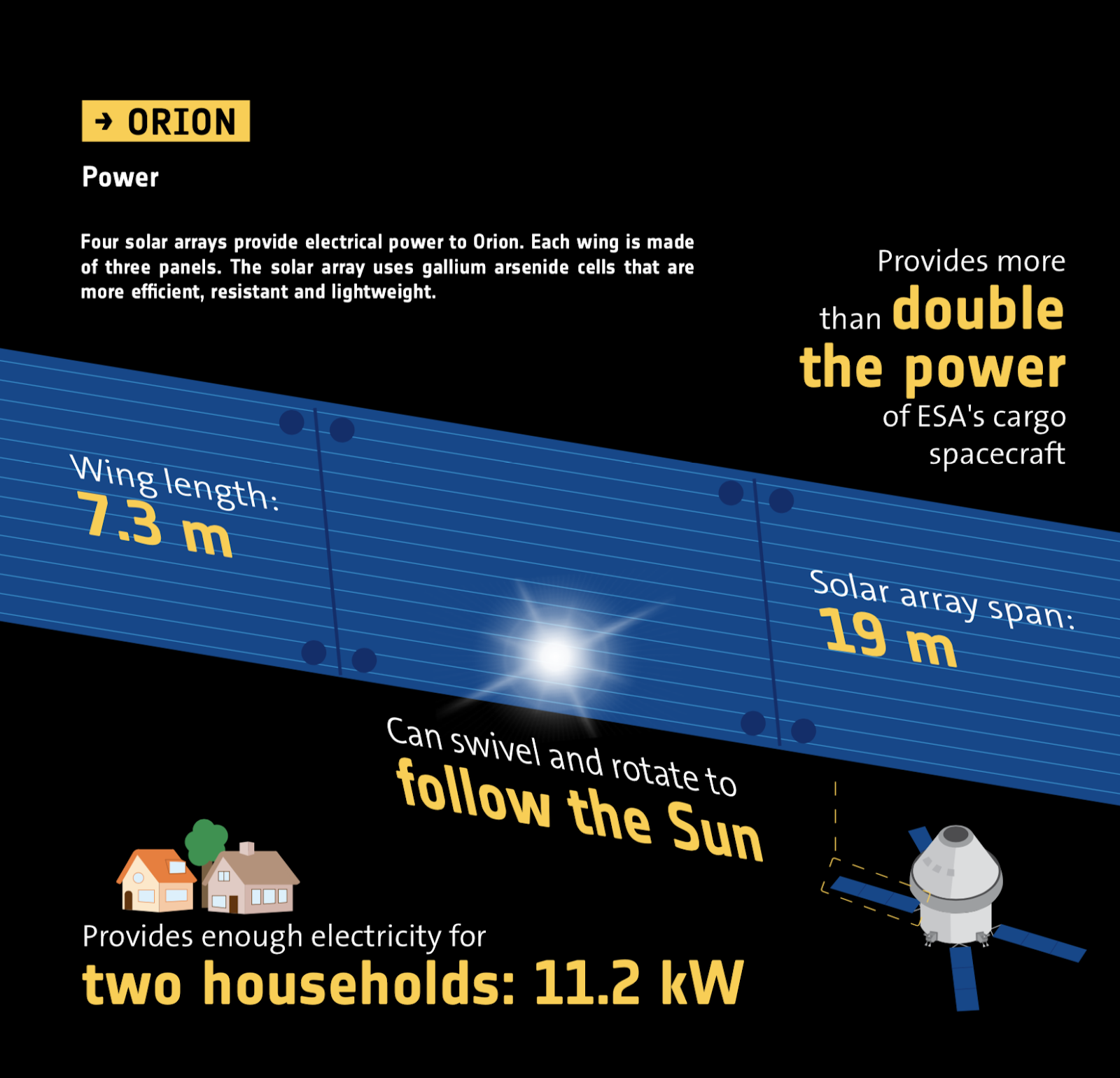
Le SM sert donc, comme l’image l’indique ci-contre, à fournir la propulsion (hélium) du véhicule, de l’eau à l’équipage et du courant grâce aux panneaux solaires (19 m de long). Et c’est là que notre pays entre en jeu avec d’autres pays européens (voir carte). RUAG à Zurich s’est occupé du mécanisme de rotation de ces panneaux. « C’est l’une des pièces essentielles du module », m’ont confié sur place Philippe Deloo chef de projet et Philippe Berthe, chef du programme du module à l’ESA. Effectivement, cela correspond un peu à la fonction de la rotule de notre genou ou notre coude. Sans cette pièce, les panneaux solaires ne pourraient plus s’orienter correctement vers le soleil. Plus de courant, plus voyage. En outre, APCO technologies à Vevey s’est occupé de la manutention du module d’Orion (comme de nombreux autres satellites) : levage, manipulation, test, positionnement, transport, etc.
Le recours à un système européen pour assurer des capacités indispensables au fonctionnement d’un engin spatial américain constitue donc une première pour la NASA. Le partenariat noué dans le cadre de la Station spatiale internationale prend ainsi une nouvelle dimension, visant cette fois l’espace lointain.
Johann-Dietrich Wörner ESA Director general during the official day. – Photo: rke
NASA/ESA – Orion. The ball joints of the solar panels are Swiss made
David Parker, Director of Human and Robotic Exploration (ESA) and Johann-Dietrich Wörner ESA Director general. – Photo : rke
[Cape Canaveral, November 27, 2018, rke] – I come back to you, like hail after the harvest, as they say in Switzerland. And in France, I suppose. NASA and the European Space Agency (ESA), unveiled Friday, November 16, 2018, in the Kennedy Space Operations Center(O & C High Bay Available SMEs), in other words, the Apollo hangar capsules refitted in assembly room of the ends of modern rockets, the Orion module. Many high personalities for this official inauguration of the Service Module (SM) were present. We did not have the opportunity to interview some leaders at that time, but later to the press conference held at the KSC Press Center.
Johann-Dietrich Wörner
ESA Director general.
– Photo : rke
Orion is NASA's new vehicle for exploring the universe. First the Moon, then Mars, then the very far away space. The spacecraft consists of two parts: one livable and the other consumable. So, it is this piece which was inaugurated and I am not very proud since it comes a little from Switzerland. This service module serves to ... serve, which means that without it, nothing can work in the livable vehicle. It's like driving a car without fuel, electricity, heat, etc.
The SM thus serves, as the image indicates it opposite, to provide the propulsion (helium) of the vehicle, of the water to the crew and the current thanks to the solar panels (62,3 feet).
And Switzerland, precisely contributed to the realization of this module… with other European countries (see map). RUAG in Zurich (Center) has developed the rotation mechanism of these panels. "This is one of the essential parts of the module," Philippe Deloo, project manager and Philippe Berthe, module program manager at ESA, told me on site. Indeed, it corresponds a little to the function of the patella of our knee or our elbow. Without this element, solar panels can no longer orient themselves properly towards the sun. Without power, no movement.
The completion of the service module in Europe signifies a major milestone in the journey toward human exploration missions to the Moon, Mars and beyond.
Au Kennedy Space Center, aussi un moment intense. - Photo : rke
[Cape Canaveral, November 26, 2018, rke (English, below] – Le hasard fait finalement bien les choses. Profitant de ce long périple américain (depuis le 13 novembre et jusqu’au 18 décembre, 35 jours), je n’ai pas loupé l’occasion de vivre l’atterrissage réussi (une fois de plus par les Américains), de la sonde InSight, ce lundi 26 novembre 2018 à 15 heures (locales), 21h (heure suisse). Ce n’est pas le gros rover Curiosity (899 kg, 1982 lb), lancé le 26 novembre 2011, qui s’est posé sur la planète rouge le 6 août 2012 – et qui roule encore, 19,75 km parcourus – mais un engin fixe de 694 kg à trois pattes qui a pour but de capter l’activité sismique dans les entrailles de Mars. J’ai donc profité de l’occasion pour me rendre au Kennedy Space Center KSC, plus précisément au hall « Journey to mars ». Certes, ce n’est pas le centre de contrôle du JPL en Californie, n’empêche que l’ambiance y était. Cela m’a un peu rappelé la tension qui a régné lors de l’atterrissage de l’homme sur la Lune en 1969. Comme quoi, le temps passe, mais les gens ne s’en lassent pas, de tels événements. D’autres visiteurs ont profité de l’écran installé au-dehors pour suivre en direct l’atterrissage. Par un temps orageux et lourd à 28 degrés C., j’ai préféré suivre l’événement à l’intérieur.
L'événement suivi sur grand écran au KSC.
Photos : rke
La France, L’Allemagne et les autres
De nombreux instituts européens, dont le Centre national d'études spatiales (CNES) et le Centre aérospatial allemand (DLR), en France, soutiennent cette mission InSight. Le CNES et l'Institut de physique du globe de Paris (IPGP) ont fourni l'instrument SEIS, avec des contributions importantes de l'Institut Max Planck de recherche sur le système solaire (MPS) en Allemagne. Puis, l'École Polytechnique Fédérale de Zurich (EPFZ) a fourni l'électronique d'acquisition de données, lesquelles seront recueillies par le Deep Space Network (DSN) qui enverra les signaux via le CNES, de l'agence spatiale française au centre de données du Service sismologique suisse de l’EPFZ, où ils seront analysés.
The Instrument Deployment Camera (IDC), located on the robotic arm of NASA's InSight lander, took this picture of the Martian surface on Nov. 26, 2018. - Photo : NASA / JPL-Caltech
NASA InSight : electronics by the Swiss institute ETHZ
[Cape Canaveral, November 26, 2018, rke] – Chance is finally doing the right thing. Taking advantage of my long-American journey (since November 13 to December 18, 35 days), I did not miss the opportunity to live the successful landing (once again by the Americans), the probe InSight, this Monday, November 26, 2018, at 3pm East. This is not the big rover Curiosity (1982 lb), launched on November 26, 2011, which landed on the red planet August 6, 2012 - and which still rolls, 12,3 miles traveled - but a 1’530 lb fixed-gear machine designed to capture seismic activity in the bowels of Mars. So, I took the opportunity to visit the KSC, specifically the "Journey to Mars" lobby. While this is not the control center of JPL in California, but the vibe was there. It reminded me a bit of the tension that occurred when the man landed on the moon in 1969. Time is running, but people do not get bored, such events. Other visitors took advantage of the screen installed outside to follow the landing lives. In stormy weather and heavy at almost 82 degrees F., I preferred to follow the event inside.
The rover Spirit in Lego.
- Photo : rke
The rover Spirit in Lego.
- Photo : rke
A number of European partners, including France's Centre National d'Études Spatiales (CNES) and the German Aerospace Center (DLR), are supporting the InSight mission. CNES, and the Institut de Physique du Globe de Paris (IPGP), provided the SEIS instrument, with significant contributions from the Max Planck Institute for Solar System Research (MPS) in Germany, the Swiss Institute of Technology (ETH) in Switzerland, Imperial College and Oxford University in the United Kingdom, and JPL. DLR provided the HP3 instrument, with significant contributions from the Space Research Center (CBK) of the Polish Academy of Sciences and Astronika in Poland. Spain's Centro de Astrobiología (CAB) supplied the wind sensors.
In the KSC. - Photo : rke
Several groups at ETH Zurich are responsible for the sensor's data acquisition and control electronics and will evaluate and interpret the acquired data from NASA's Deep Space Network (DSN). The DSN transmits the signals via the French space agency, CNES, to the data center of the Swiss Seismological Service at ETH Zurich, where they are analyzed.
Currently, AEIL is involved in the Phase B, which will end with an Engineering Model (EM) in 2013. The Swiss industry will develop the flight hardware by the end of 2014. This is an extremely challenging schedule for ESA, NASA and all institutes involved.
Le Brigadier Abdulaziz Falah al-Dosari (à gauche) sur le site de lancement et son assistant. - Photo : rke
Décollage de Falcon 9 le
15 novembre 2018. - Photo : rke
[Cape Canaveral, November 24, 2018, rke (English, below] – Dix jours après le lancement de Falcon 9/Es’hail 2, le 15 novembre 2018 à 15h46 (locale), 21h46 (heure Suisse) de Cap Canaveral, je reviens sur cette mission. Eh oui, je suis toujours à Cap Canaveral ! Après une semaine très intense pour terminer le magazine Swiss Engineering RTS du mois de décembre, je peux enfin me re…consacrer aux fusées. Au bout de six mois, ce décollage a eu lieu enfin à l’heure. Tiens, comme par hasard, cela se passe souvent quand je suis sur place. Et c’est plutôt rare, SpaceX demandé à la NASA de bloquer toutes les routes qui mènent au pas de tir, y compris celle du centre des visiteurs. J’ai donc été escorté sur place avec un bus spécialement aménagé pour les étrangers. Du coup, je me suis retrouvé seul avec l’équipe de la télévision du Qatar. Au début, j’étais un peu méfiant de voir un journaliste enturbanné en blanc, mais après une longue attente où il a fallu énormément de patience pour attendre le décollage, j’ai eu le temps de me rendre compte que ces Qataris sont très ouverts et amicaux, contrairement à l’idée qu’en se fait d’eux.
Toujours surveillé jusqu’aux toilettes
Mon gardien de SpaceX a quand même voulu prendre
ce selfie de moi.
Comme d’habitude, j’étais surveillé pour mes moindres faits et gestes, même pour aller aux toilettes (la politique de SpaceX), et il m’a fallu attendre jusqu’à la fin des transmissions directes des TV qatariennes, soit deux bonnes heures après le décollage, pour repartir. Oh, miracle, le gars de SpaceX m’a remercié pour ma patience. Bien m’en a pris puisque j’ai pu faire la connaissance du Brigadier Abdulaziz Falah al-Dosari, assistant en technologie, le ministre d’État aux Affaires de la défense du Qatar. Celui-là mêmecqui a signé en 2016 un contrat pour l’achat de 114 Airbus A 340, puis en décembre 2017 de 50 Airbus A321 et 12 Rafale.
Es’hail-1 lancé par Ariane en 2013 déjà
Artist’s concept of Es’hail 2. Credit: Es’hailSat
Pour la petite histoire, le satellite Es’hail-2, de construction japonaise, est exploité par la société publique Qatar Satellite Company, également connue sous le nom de Es’hailSat. Falcon 9 a placé le satellite Es’hail-2 sur une orbite de transfert géosynchrone, le satellite devant alors atteindre son dernier créneau en orbite géostationnaire de son propre chef. Mais Es’hail-1 de l’État du Moyen-Orient a été lancé conjointement par Es’hailSat et l’opérateur de télécommunications français Eutelsat. Anciennement Eutelsat 25B, il a été déployé par une fusée européenne Ariane 5ECA en août 2013. Placé à 25 degrés Est, le satellite Es'hail-1 devait fonctionner pendant au moins quinze ans à compter de lancement.
D’autre part, Falcon 9 embarquait la première charge utile d’un satellite radioamateur à voler en orbite géostationnaire, c’est-à-dire fixe au-dessus de nos têtes. Ses deux transpondeurs disposeront d’antennes à large faisceau qui couvrent environ le tiers de la surface de la Terre. Une équipe d'amateurs, dirigée par Peter Guelzow DB2OS (président d'AMSAT-DL), apporte un soutien technique à ce projet novateur qui devrait offrir une nouvelle phase d'activité passionnante aux radioamateurs pour le 21e siècle.
Ah, au fait, après l’achat d’Airbus, le Qatar va-t-il s’offrir des fusées ? Ils en auraient les moyens…
SpaceX/Falcon 9 :
Qatar's money for Airbus – for rockets, too?
The Qatari TV presenter. - Photo : rke
[Cape Canaveral, November 24, 2018, rke] – Ten days after the launch of Falcon 9 / Es'hail 2, November 15, 2018, at 3:46 pm, from Cape Canaveral, I’m back. Yes, I'm still in Cape Canaveral! After a very intense week to finish Swiss Engineering RTSmagazine in December, I can finally get interested in these rockets. After six months, this takeoff finally took place on time. By chance, this happens often when I'm there. And it is rather rare, SpaceX asked NASA to block all roads leading to the shooting range, including that of the visitor center. So I was escorted on site with a bus specially designed for foreigners. As a result, I found myself alone with the Qatar TV team. At first, I was a little suspicious of seeing a journalist in a white turban, but after a long wait where it took a lot of patience to wait for the takeoff, I had time to realize that these Qataris are very open and friendly, contrary to the idea we have of them.
Brigadier Abdulaziz Falah al-Dosari (left)
at the launch site. - Photo : rke
Always guarded to the toilet
As usual, I was watched for my every move, even to go to the bathroom (the SpaceX policy), and I had to wait until the end of direct transmissions Qatari TV (around two hours after takeoff), to leave again. Oh, miracles, the SpaceX guy thanked me for my patience. Fortunately for me, because I got to know the Brigadier Abdulaziz Falah al-Dosari, Assistant for Technology to the Minister of State for Defence Affairs. The same personality that signed in 2016 a contract for the purchase of 114 Airbus A340, then in December 2017 of 50 Airbus A321 and 12 Rafale.
Photo : rke
Es'hail-1 was launched by Ariane in 2013 already
For info, the Japanese-built Es’hail-2 satellite is operated by the state-owned Qatar Satellite Company, also known as Es’hailSat. So, Falcon 9 placed the Es’hail-2 into a geosynchronous transfer orbit, with the satellite expected to then reach its final slot in geostationary orbit under its own power. But the Middle-Eastern state’s existing Es’hail-1 satellite was launched as a joint venture between Es’hailSat and French telecommunications operator Eutelsat. Es’hail-1, which was formerly also known as Eutelsat 25B, was deployed by a European Ariane 5ECA rocket in August 2013. Stationed at 25 degrees East, the Es’hail-1 satellite was expected to operate for at least fifteen years from launch.
Then, Falcon 9 boarded the first charge of a radio amateur satellite to fly in geostationary orbit (to say fixed above our heads). Its transponders have broad beam antennas to provide full coverage over about 1/3rd of the earth’s surface. A team of amateurs, led by Peter Guelzow DB2OS (President of AMSAT-DL) are providing technical support to this groundbreaking project which is expected to provide an exciting new phase of activity for radio amateurs for the 21st century.
Ah, finally, after the purchase of Airbus, will Qatar offer rockets? It would have the financial means…